

Managing Beech Trees in the Face of Beech Leaf Disease
By Brandon Tennis, Senior Vice President of Stewardship
Native trees, shrubs, and herbs have evolved with pests and diseases over long spans of time. If this long-term co-evolution hadn’t occurred, then our forests would have no resilience, and every pest would result in an infestation, and every disease would result in an epidemic. Globalization, however, has introduced new vectors, and erratic climate has compounded environmental stressors. The ability of species to adapt to pests and diseases through co-evolution is being outpaced, resulting in detrimental impacts to both individual species as well as entire habitat types. Elm and chestnut are the famous American case studies for species decimated by introduced pests and diseases, but significant decline in hemlock and ash have devastated the eastern United States in our more recent lifetimes.
And now, beech leaf disease (BLD) is ravaging entire American beech stands across our favorite landscapes including Shiprock Woods, Tucquan Glen, Ferncliff, and Mill Creek Falls nature preserves. Look up and you’ll see banded and withered leaves, crown dieback, and desperate new growth coming from formerly dormant buds beneath the trees’ bark.
BLD was first discovered in Ohio in 2012 and then spread into northwestern Pennsylvania by 2016. It moved quickly across the state from 2020 through 2022. BLD was first discovered within the Conservancy’s portfolio of preserved lands in 2023 at a conservation easement in the Furnace Hills region of Elizabeth Township, Lancaster County. Within just two years, BLD infected beech trees across the Conservancy’s preserves in both Lancaster and York counties.
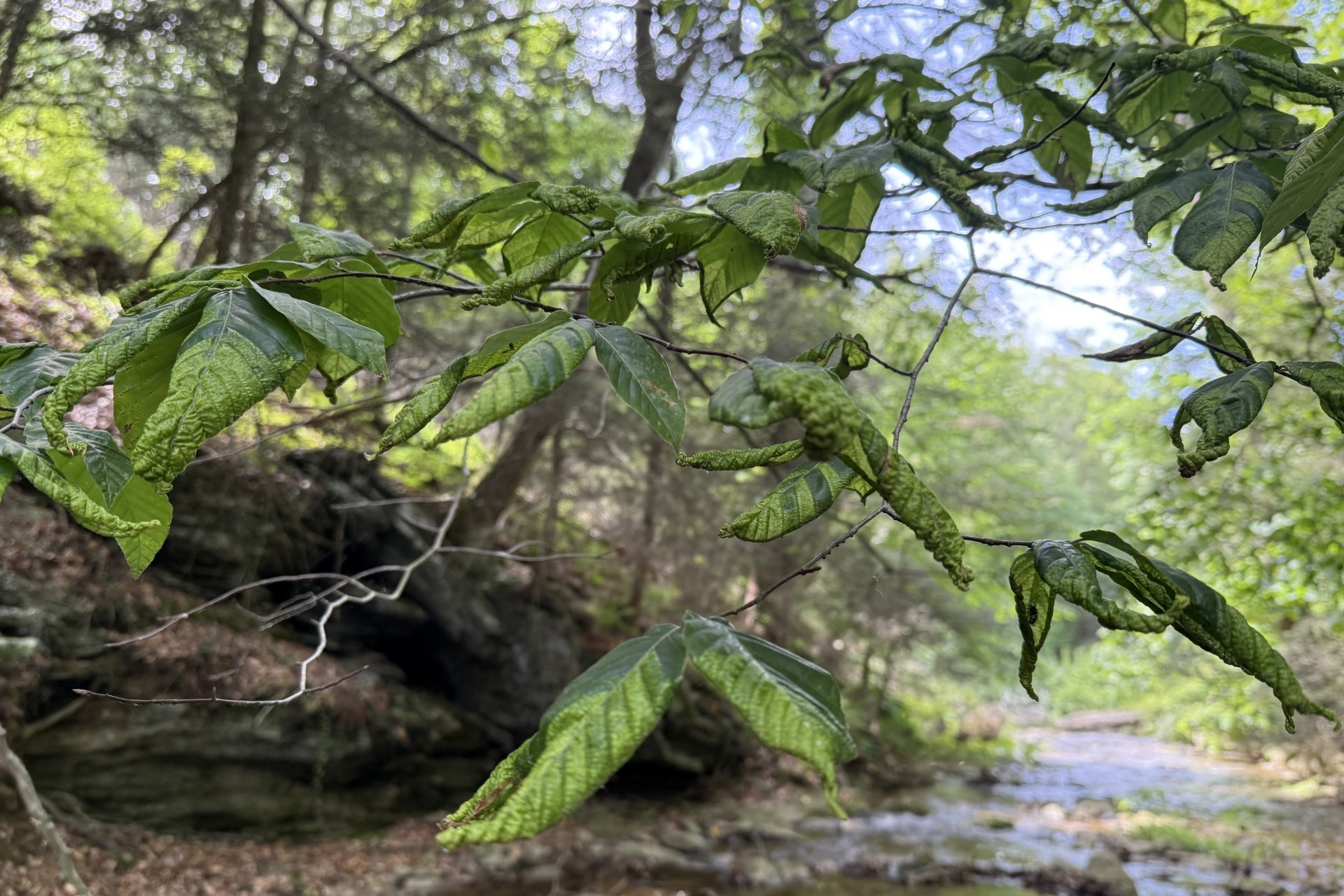 Leaves impacted by beech leaf disease (Photo by Eric Roper)
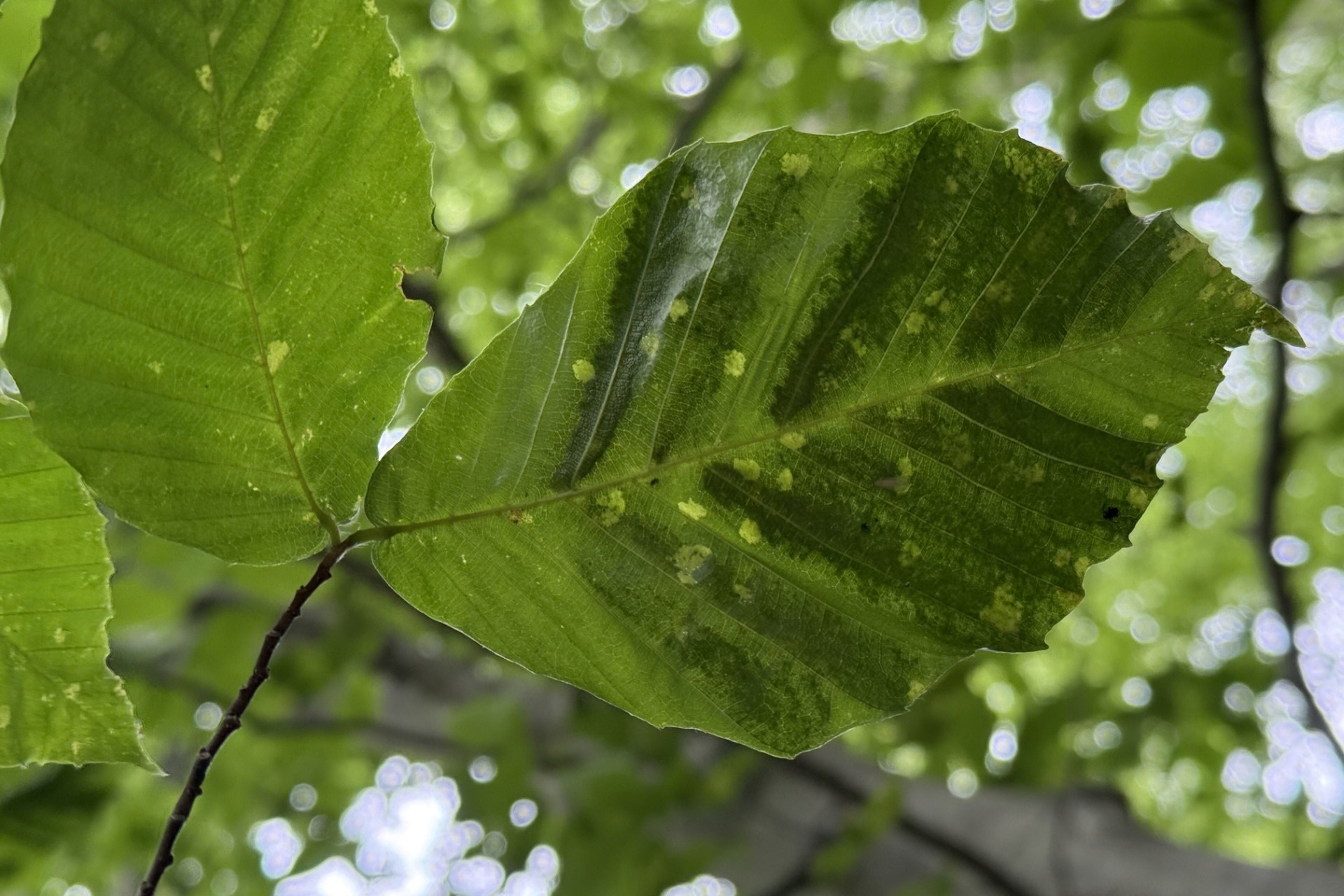 Leaf impacted by beech leaf disease (Photo by Eric Roper)
All treatment options for BLD to date are infeasible due to prohibitive expense, excessive water use, and environmental toxicity. Because there is no landscape level treatment for BLD (for treating forests rather than single specimen trees), the Conservancy had to wait – uncomfortably – while researchers and land managers searched for a solution, if any could be found. Although there still is no treatment appropriate for entire preserves, the Conservancy has joined the movement that holds promise from researchers in Ohio. While it is too early in the epidemic for long-term studies, Ohio researchers have had the greatest amount of time to experiment.
The Conservancy has targeted its most significant beech communities, established test plots, and begun an effort to boost the immune response of understory beech cohorts with nontoxic, high-potassium fertilizer, which is more traditionally used in agriculture but also available to homeowners in regular retail stores.
According to the Connecticut Agricultural Experiment Station analyzing data from Ohio arborists, potassium phosphite triggers biochemical defenses against disease-causing organisms and appears to interfere with the ability of BLD-causing nematodes to modify the development of leaves within buds of beech trees. This response allows beech trees to prevent cell manipulation otherwise necessary for the nematode to overwinter – essentially countering the nematode’s ability to create the environment that it needs to survive. Giving the tree an opportunity to control the population growth of the nematode preserves the tree’s ability to more fully foliate, photosynthesize, and respond to attack. So, potassium phosphite is not a nematode insecticide but, rather, an immune system support for the tree.
The caveat to the promise of phosphite treatment, however, is that only small diameter trees (2-10 inches) have demonstrated a positive response. Effectiveness appears to decrease with tree size. Unfortunately, once the nematode is established, large, mature beech trees show no signs of resistance even with the phosphite treatment. Which means that the stately beech groves of our favorite preserves are progressively dying. The hope of the phosphite treatment is in future cohorts of beech trees reestablishing these once majestic groves. The task for the Conservancy, therefore, is not just in early treatment of young beech trees but also in long-term, overall forest management to retain the site conditions for new beech groves to reclaim their previous positions.
Until then, dead and dying mature beech trees are fast becoming hazard trees to the public’s enjoyment of the Conservancy’s nature preserves. And, as such, our field staff will be felling only those trees in decline that are within striking distance of trails and parking areas. All non-hazardous beeches in decline will be retained, as they stand, to decay naturally and continue to provide the habitat (especially for cavity nesting birds) and nutrient cycling that is promised in their stately glory of old age and death in the forested landscape.
The Threat Facing Our Forests
By Keith Williams, Vice President of Engagement & Education
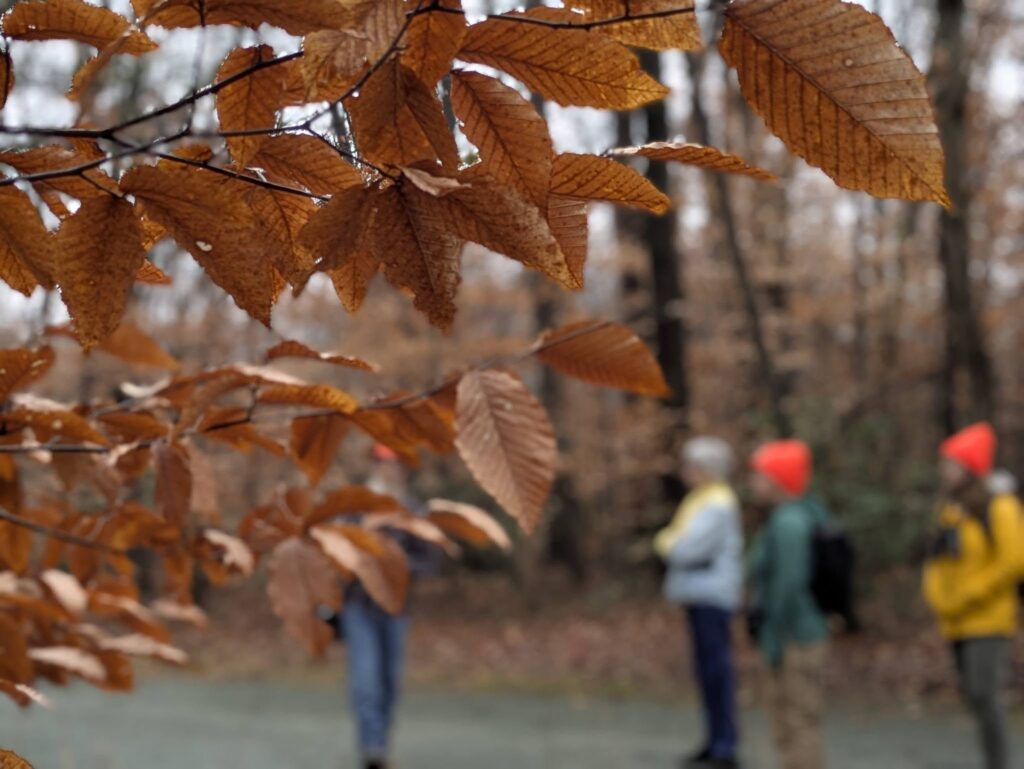
It was winter. All the leaves were off the trees except for the beech, and so the forest glowed yellow and auburn. Unlike most deciduous trees, beech trees keep their leaves through winter as a defense against deer and harsh weather until the new spring growth pushes the old leaves off. I didn’t realize how much those beech trees define the wintertime forest until this year. I’m paying more attention because they are going away.
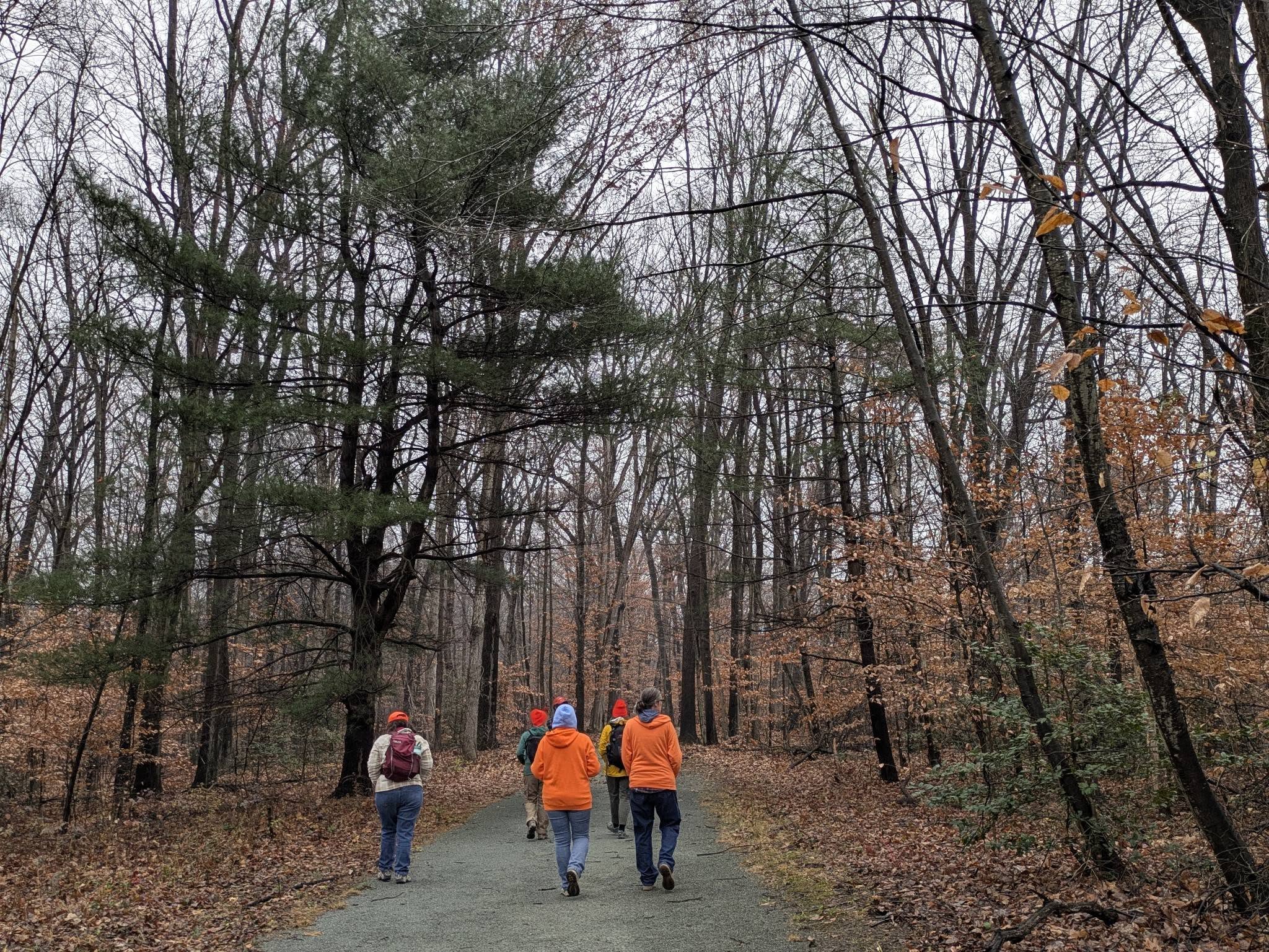 Beech trees keep their golden brown leaves through the winter, as seen along this trail at Mill Creek Falls Nature Preserve (Photo by Peggy Eppig)
The beech tree’s ingenious old leaf-holding strategy protects against hungry deer, but it isn’t effective against beech leaf disease. Beech leaf disease has infested beech trees on our preserves and has rapidly progressed in a year’s time from the northern part of our coverage area to our more southern preserves. Unfortunately, beech leaf disease can now be found in all 67 counties in Pennsylvania and throughout much of the eastern United States.
It’s caused by nematodes – Litylenchus crenatae mccannii – that feed inside the leaf buds, disrupt cell function, and ultimately kill the trees they infest. Nematodes are microscopic worms. There are estimated to be millions of species of nematodes, but only a few thousand have been named. Not all are harmful. Many are essential to tree health. Any shovelful of soil contains thousands of nematodes that eat bacteria and fungi and are key parts of healthy soil ecosystems. This one, Litylenchus crenatae mccannii, however, is killing our beech trees. It was originally found and isolated from Japanese beech trees and was first discovered in North America in Ohio in 2012. It is suspected that beech leaf disease was probably brought to this continent on landscaping material imported from Japan.
We still don’t know much about the beech leaf disease process, how to protect beech trees against it, or how it spreads, but we know it moves fast. At the pace it’s progressing, I expect the beech trees at Climbers Run Nature Center to not make it another year or two, so I spend a lot of time taking pictures of the woods right now so I can show future generations what was.
The loss of beech trees goes far beyond the change in our wintertime forest color pallet, because to paraphrase John Muir, when you pull on one thing, you find it connected to everything else. So as the invasive nematodes pull beech trees from our landscape, other impacts are likely to follow.
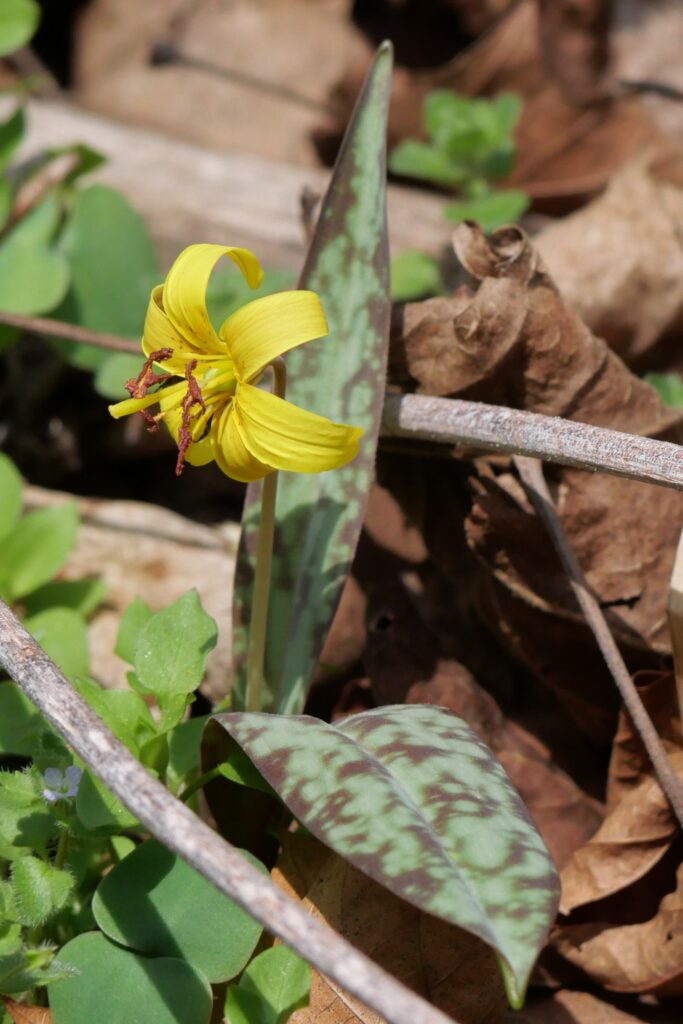
Yellow trout lily (Photo by Avery Van Etten)
What effect will the loss of beech trees have on our forests? There is a reciprocal relationship between trout lilies and beeches. Lilies seem to be more abundant where beech trees are. Beech trees create the right rich soil and shaded conditions the trout lilies need, which allows the trout lilies to establish long-lived colonies. In return, the trout lilies pass nutrients through their roots to the roots of trees. What happens to the trout lilies when the beech trees go away, and what happens to the early springtime pollinators that depend on those trout lilies when the mutualistic ties between the beech and the lilies are severed?
What happens to the insects that depend on beech trees, such as saddled prominent moths? Saddled prominents are beautiful emerald green moths that look like flying bits of moss. Their caterpillars are a smooth brilliant green with yellow lines and brown patches that make them look like leaves, and they feed on beech leaves. When beech leaves go away, food for saddled prominents goes away too.
Beech nuts form part of the forest mast crop with other nuts – acorns, hickories, and historically chestnuts. These packets of stored energy are critically important to the feeding ecology of our woods, and several organisms depend on it – everything from bears to birds. The loss of beech trees will reduce the available mast, which will have a bottom-up effect on the forest system. Less food means fewer bears, deer, foxes, chipmunks, birds.
Our forests will go on without the beech trees and anything else taken with them – perhaps the trout lilies and saddled prominents. But they will be different. The ecological mechanics will be changed. Energy flow and relationships altered. The spirit of the place will be diminished because beings that are part of this landscape will be gone.
Change is a normal part of life. Nothing is static in nature, everything is dynamic. The question is, what happens when these significant changes happen rapidly? Is there a point at which the resilience ends and the system snaps?
→ LEARN MORE: “Nature’s Least Wanted: Invasive Species Threatening Our Landscape”
It’s not the first time our forest has gone through a complete restructuring. The forests that are here now are significantly altered, though some may consider them pristine because we are collectively losing the memory of what they were. I wonder if this was how it felt to watch the mighty chestnuts disappear from our landscape. These towering redwood-sized trees, ancient beings who defined the spiritual feel of our forests in eastern North America and dominated the feeding ecology of our forests with their nuts, were eliminated from our woodlands 75 years ago due to a fungal blight.
The loss of the chestnuts, and all the energy and nutrition they contained, contributed to the loss of Allegheny wood rats and the reduction in the range and abundance of timber rattlesnakes. Three beings that helped define our eastern forests. American chestnuts have been part of this landscape for 40 million years. Timber rattlesnakes have been here for 3 million. Woodrats are the newcomers, having been a part of this ecology for 20,000 years. The woodrats fed on chestnuts; the rattlesnakes fed on the woodrats. When the American chestnut went away, that sent a cascade of effects up through the food chain. Twenty thousand years of reciprocity lost in the span of 50 years due to the introduction of a non-native blight.
Beech tree at Mill Creek Falls Nature Preserve (Photo by Peggy Eppig)
I want to rail against the inevitable. But that’s just wasted mental, emotional, and physical energy. No amount of kicking and fighting and screaming is going to reverse the damage that will befall our forest. Things will adapt, and I need to accept the change. I need to accept what is out of my control, channel that anger into something that can make a difference.
Mechanically, the void will be filled. Another species will move in and take over, become dominant. Something will take the beeches’ place in the canopy, but nothing can replace their unique presence, the specifics of their existence. The upshot in ecology is that life adapts and carries on. The standing dead wood that was once majestic live beech has utility. Decomposing insects will invade, fungi will initiate rot. Woodpeckers will excavate cavities and owls will move in. Nothing goes to waste.
The loss of beech trees is more than a shift in feeding ecology and energy flows. The timelessness of the place is replaced with new additions, and the ethereal feel becomes less. This is part of the current homogenization of our global ecology. We are spreading species across the planet which results in reduced diversity, that translates to a loss of the spiritual essence and character that makes the sense of place feel special and unique.
Ecologically the forests’ value may be the same depending on our perspective. Energy will flow, new feeding relationships will establish, new reciprocities will form. But the forest will never be the same. The loss of the auburn beech leaves that give our snow-covered forests a warm glow and rattle in the winter wind will lessen the etherealness of the woods. The timelessness of them. The forest will never be the same. Neither will we. We can never go back to what was. But we can heal and move forward. The forest can heal too, and maybe if I direct my anger at thoughtful restoration, I can help the forest move forward into a new spiritual essence.